How Interest Rates Affect Bond Prices and NCD Returns
Investors often see bonds and Convertible Debentures (NCDs)
as safe and stable investment options that provide fixed returns. However, an
important factor affecting their performance is that interest rates affect bonds.
Understanding the ratio of interest rates, bond prices, and NCD returns can help
investors make better financial decisions.
The Inverse Relationship Between Interest Rates and Bond Prices
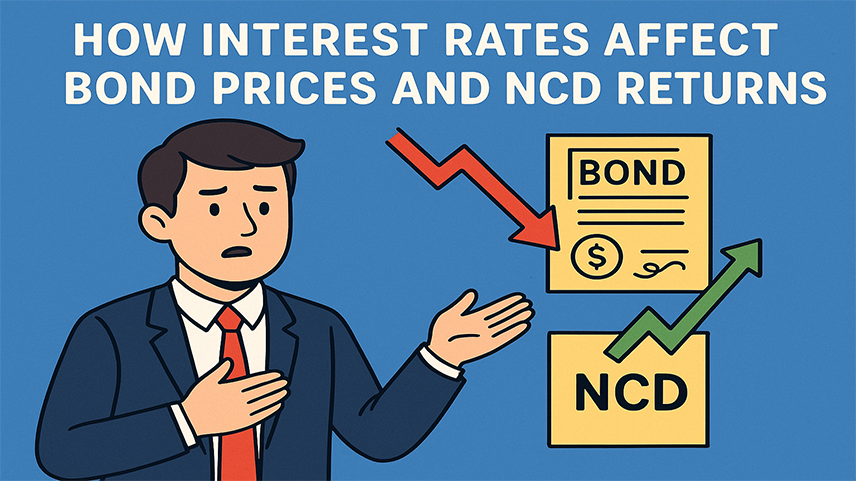
The price of bonds and NCDs moves in the opposite with interest.
Here's the reason:
- When interest rates increase, recently issued bonds and NCDs offer high coupon prices (interest payouts). Older bonds/NCDs with lower coupon prices become less attractive, leading to a drop in their market price.
- When interest rates fall, the existing bond interest rates and prices and NCDs with higher coupon rates become more valuable, leading to an increase in market value.
Example:
If you hold 8% interest to NCD, the market is starting to
offer new NCDs at 9%, your current NCD will trade on exemption as investors
prefer higher returns.
Key Concepts Investors Should Know
• Yield to Maturity (YTM): If bonds/NCDs are kept to
maturity, the total return must be. Increasing interest rates are
increasing for new buyers, but reducing prices for existing holders.
• Duration: A measure of sensitivity to a
bond/NCD for changes in interest rates. The higher the period, the higher the
price will fluctuate with interest rate movements.
• Callable bonds/NCDs: Some issuers can repay before
maturity when interest rates fall, and limit the investor's capacity to take
advantage of the price.
Strategies to Manage Interest Rate Risk
1. Invest in both short-term and long-term bonds/NCDs to
balance diversity during the term of office.
2. Team approach - Spread investment in different
decay, so that all funds are not closed at the same interest rate.
3. 3rd priority for safe NCDs -In the
growing environment, safe NCDs provide more protection than unsafe people.
4. Stay up to date -keep track of the central bank's
guidelines (such as RBI -Repo interest changes) as they directly affect bond
rates.
Conclusion
Interest rates play an important role in determining the
market value of bonds and NCDs. While long-term investors hold maturity,
they do not consider significant value risks; people who are active in the secondary
market must look carefully at the interest rate movements. By understanding
this reverse relationship and using smart strategies, investors can protect
their portfolio and even benefit from interest rates.
Read Also
How Safe Are NCDs Compared to BondsThe Dark Side of Digital Gold: Disadvantages You Need to Know

0 comments