How to Read and Analyse Option Chains
Options trading gains popularity among traders for its
flexibility, utilization, and ability to handle risk. But in order to make
informed decisions, traders must understand how to read and analyse alternative
chains. An alternative chain, also called the Options Matrix, provides all
available alternative contracts for a specific stock or index single view.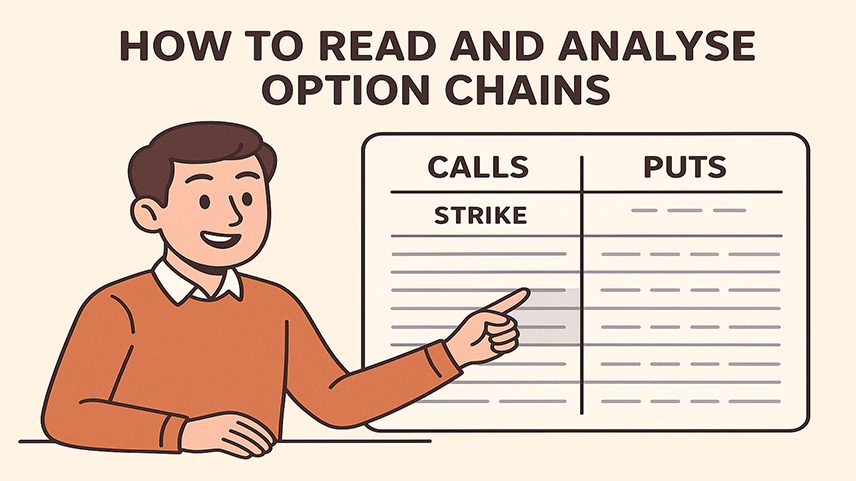
What is an Option Chain?
An option chain is a list of all available calls, and
a specific underlying asset sets an alternative contract, for example, with
details:
• Strike prices
• Premium (option price)
• Open interest (OI)
• Volume
• Expiry dates
• Ask bids/prices
This option acts as a snapshot of demand, supply, and spirit
in the market.
Key Components of an Option Chain
1. Call (CE) and PUT (PE) options
• Call (CE): Buyer provides rights (liability) for buying the underlying asset.
• Puts (PE): Do not provide rights (liability) to the
buyer to sell the underlying property.
Alternative chain shows call on one side and puts on
another for easy comparison.
2. Strike Price
The predetermined value that the option can be used for. Strike
prices are listed in the centre of the chain.
3. Premium (Last Traded Price – LTP)
The price at which the option is currently trading. The prize
depends on factors such as expiry, instability, and time for internal value.
4. Open interest (oi)
The outstanding exit indicates the total number of
contracts. High OI reflects strong market activity and interest in the strike
price.
5. Volume
The number of contracts that do business during the day. High volume means that the strike is actively traded.
How to Analyze an Option Chain
1. Identify support and resistance levels
• High conversation OI at the strike price often acts as
resistance.
• High put OI at the strike price often works as support.
2. Look for a change in open interest
• Rising Call OI = bearish sentiment (more traders
expect the price to stay below that strike).
• Rising Put OI = bullish sentiment (more traders expect the price to stay above that strike).
3. Monitor inherent Volatility
• High IV suggests expensive prizes and more uncertainty.
• Smaller IV indicates cheaper options and calmer markets.
4. Watch Volume Along with OI
If both volume and OI grow, it confirms a strong interest in
that strike.
Example: Using an Option Chain
Suppose nifty trading to 19,800:
• High Set OI 19, 700 → In strong support zone.
• 20,000 → High conversion OI in resistance field.
This suggests that Nifty can trade within this area until Oi
is significantly offset.
Conclusion
Reading and analyzing an option chain is a skill every
options trader must develop. By studying open interest, premiums, volumes, and
implied volatility, traders can gauge market sentiment, identify support and
resistance zones, and make smarter decisions. Remember, option chains don’t
guarantee outcomes, but they provide powerful insights to enhance your trading
strategies.
Read Also
The misconception of Option trading
How to Use the Box Spread Strategy for Safe, Fixed Profits

0 comments